

Family Caregiving
Family Caregiving
The people who are not in the room every day may not always understand what it costs you to be the one who is. But you know. And it is okay to make it a little easier on yourself.
Carespondence was built by someone who lived this. If you are looking for a simpler way to share updates and keep your family informed without it becoming another job, you can learn more at carespondence.com.
Less explaining does not mean less caring. It means you are protecting your own capacity so you can keep showing up for the person who needs you most.
And it is okay to name that. Even quietly, just to yourself.
The gap that nobody talks about
There is a natural divide that forms in caregiving families, and it is not always about effort or intention.
You are seeing things firsthand. The small changes. The hard moments. The way things look on a Tuesday afternoon versus how they looked three weeks ago. You have a full picture because you are in it every day.
Your siblings have snapshots. What they hear from you. What they see on a visit. What they piece together from the outside looking in.
That gap is not anyone's fault, but it is real. And it creates a kind of distance that can be hard to bridge, even when everyone involved cares about the same person.
You cannot always explain what you are seeing in a way that lands the same way it feels. And your siblings cannot always understand what they are not there to witness.
That tension tends to live quietly under the surface of a lot of family caregiving situations, even in families that are otherwise close.
A few things that actually help
You do not need a system. You just need a little less friction.
One update in one place can go a long way. A group text. A shared note. A simple email thread. Something where you can post once and reach everyone at the same time instead of repeating yourself across separate conversations.
It does not need to be detailed. It just needs to exist.
Short and consistent works better than thorough and occasional. A brief update once a week, even just a few sentences, tends to reduce the number of individual check-in calls you get. When people know they will hear from you regularly, they are less likely to reach out in between wondering what is going on.
You can also set a simple expectation. Something like: I will send an update on Sundays unless something changes and I need to reach out sooner. That one sentence can quietly shift how your family communicates with you, without requiring a big conversation about it.
You are not obligated to explain everything every time. A short update is still an update.
You are not supposed to carry this perfectly
Being the primary caregiver does not also mean being the perfect family correspondent.
You are allowed to simplify how you share information. You are allowed to stop repeating yourself. You are allowed to find a way that takes less out of you, even if it means people get a little less detail than they are used to.
There is a particular kind of drain that comes from being the person everyone else relies on for information. It does not feel like anger exactly. It feels more like weight. Like one more thing sitting on a pile that is already too tall.
Nobody assigns you the role of family communicator.
It just becomes yours.
At some point, you became the one who knows what is happening. You are at the appointments. You are making the calls. You are watching things change day to day in ways that are hard to explain in a text message. And because you know, everyone starts coming to you.
How is she doing? What did the doctor say? Is she eating? Is she sleeping? Did something happen?
You answer. Because of course you do. They are your family and they care. So you answer, and then you answer again when the next sibling asks the same thing, and then again when someone follows up on the follow-up.
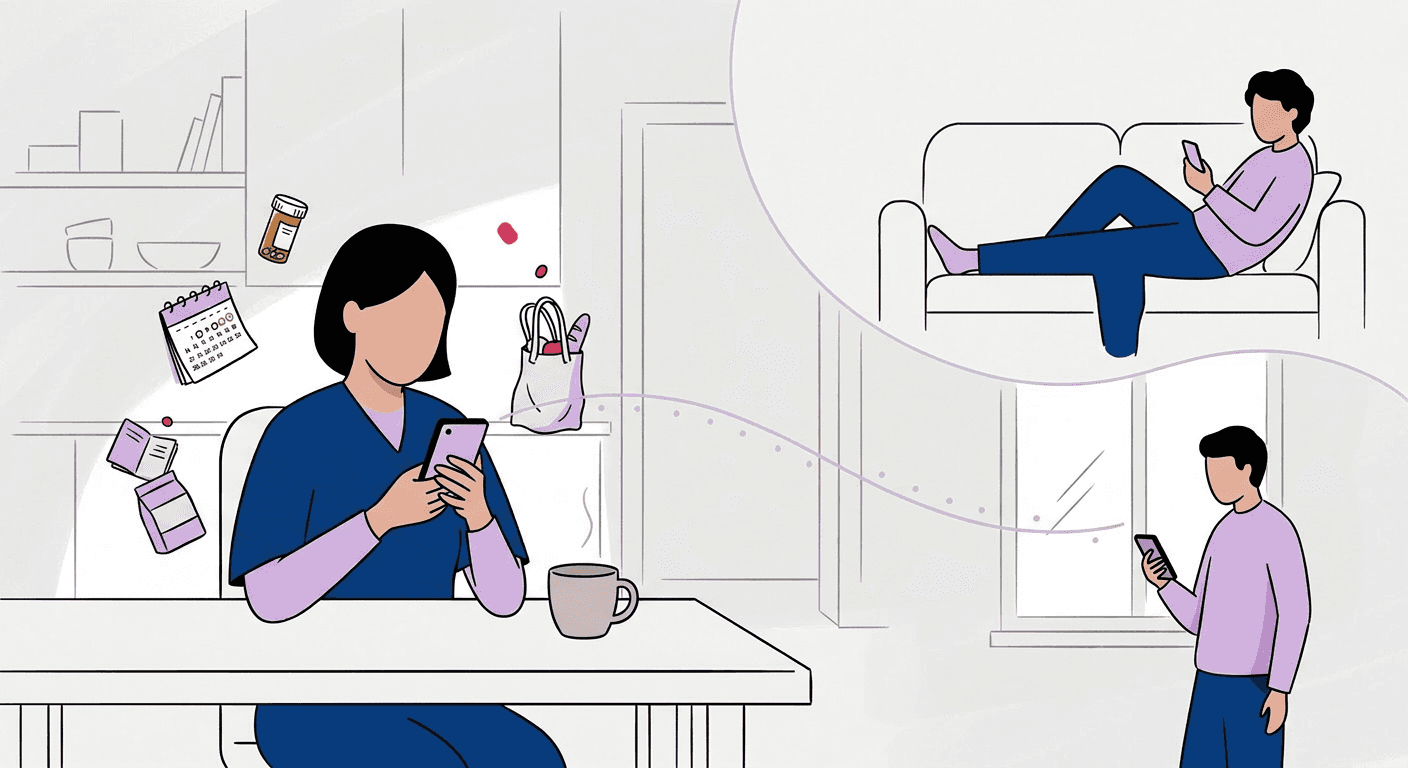
And at some point, without really deciding to, you are doing two jobs. The caregiving. And the reporting on the caregiving.
The part that wears you down
It is not usually one conversation that gets to you. It is the accumulation of them.
Telling the same story three different times to three different people. Remembering what you told one sibling versus another. Trying to give everyone enough detail that they feel informed without turning every call into a full medical briefing.
And the hard part is that each individual ask makes sense. Of course your brother wants to know how your mother is doing. Of course your sister has questions about the last appointment. None of it is unreasonable on its own.
But you are the one fielding all of it. Every time. On top of everything else.
Most people do not wake up and decide they are going to become a caregiver. It happens in pieces.
Caregiver Wellbeing

Caregiving does not usually announce itself. It builds. Quietly. One extra task at a time.
Family Caregiving